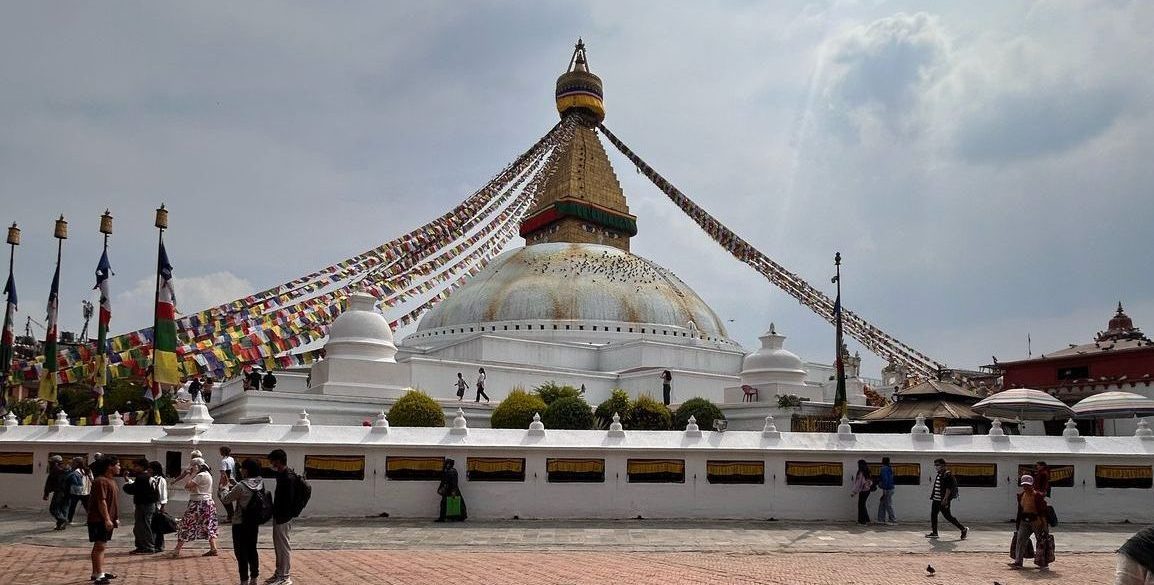
Silence around the Boudha Stupa in Kathmandu speaks louder than sound. Golden prayer flags flutter in the air. Prayer wheels spin with a quiet rhythm. Amidst this, Boudha Stupa rises tall, white, and calm.
You stand there, still, while the world moves in slow circles around you. For hundreds of years, this place has held space for faith, for footsteps, and for stories.
Before planning a trip, if you’re curious about Boudha Stupa, stay with us.
Highlights
- History Behind Boudha Stupa!
- The UNESCO Badge of Honour!
- Architecture Behind Boudha Stupa!
- Spiritual and Cultural Pulse of Boudha!
- Annual Festivals Celebrated!
- Places Worth Visiting Around Boudha Stupa!
- Frequently Asked Questions!
History Behind Boudha Stupa!

Manish Giri
The legend of Boudhanath Stupa is etched on its giant white dome. Its golden tower has been watching for centuries, and it’s all-seeing eyes are painted on it. It has seen many an empire rise, earthquakes hit, monks pass by in prayer, and tourists fall quietly into awe.
But where did it come from?
Locals say a humble poultry keeper named Jadzima built it with the help of her sons. She asked the king for land, and he absentmindedly gave her the go-ahead. With the help of her four sons, she marked the land using a single buffalo hide cut into a long strip- pretty smart! The king couldn’t take his word back, and that’s how the site came to be.
Legends aside, historians believe the original structure was built during Nepal’s Licchavi period, around the sixth century. It was meant to house the relics of Kassapa Buddha, one of the Buddhas of the past. Over time, that small act of devotion became one of the biggest Buddhist stupas in the world.
When Tibet fell under Chinese rule in 1959, many Tibetans fled to Nepal and settled around Boudhanath. They brought their culture, monasteries, prayer flags, butter lamps, and chants, transforming the area into a mini-Tibet in Kathmandu.
In 2015, a devastating earthquake damaged the stupa. But people didn’t let it fall. Monks, locals, and donors came together to rebuild brick by brick and prayer by prayer.
The UNESCO Badge of Honour!

Manish Giri
In 1979, Boudha Stupa earned its rightful place on the UNESCO World Heritage list. It’s a mark of global cultural importance.
With its towering white dome and watchful golden eye gazing in every direction, Boudhanath feels sacred and cinematic at once. This prestigious title places it firmly on the world map as a must-visit for culture lovers and history geeks.
Walk into Boudhanath today, and you’ll see monks in maroon robes chant their way around the stupa. Locals and pilgrims walk clockwise, murmuring mantras.
And guess what?
It’s also one of the few places in Nepal where Tibetan culture is so beautifully preserved, especially post-1959, when many Tibetans fled here.
Architecture Behind Boudha Stupa!

Manish Giri
Set your feet on the premises, and you’re gently pulled in. There’s a kind of quiet rhythm in its shape, something that feels grounded, thoughtful, and deeply intentional. You might not catch every detail at first, but that’s the beauty of it- the closer you look, the more it reveals.
Let’s start from the ground up. The stupa is built like a giant mandala- basically, a sacred map of the universe. But you don’t need to be a monk to appreciate it. Just walking around it (yes, clockwise!) with the prayer wheels spinning beside you feels like entering a calmer dimension.
The central dome is hard to miss. White, round, and grounded. It represents the Earth. Simple, right?
But it’s also said to symbolise the womb- the place where all beings begin.
Then there’s the square structure on top, called the harmika. This is where things get a little mystical. Four sides. Four pairs of painted eyes. And no, they’re not judging you. Those “Buddha eyes” are there to watch over the world with compassion and not surveillance.
Just below the eyes, a spiral that looks like a question mark?
That’s actually the Nepali number 1, standing for unity and the one true path.
Higher up, there are thirteen golden tiers. Each step represents a stage on the path to enlightenment. You don’t climb them physically. But ponder them. Quietly.
At the very top sits a little parasol- yes, a parasol!
It’s the finishing touch, representing space and the vastness of spiritual freedom.
There’s so much more to the architecture, but we’ll leave it to you to behold and dissect on your visit. What’s stunning is how the entire structure looks perfectly symmetrical, yet feels entirely human. It’s not flashy. It’s intentional. And it’s been quietly standing there- unchanged and unshaken- for centuries.
Spiritual and Cultural Pulse of Boudha!

Manish Giri
Have you ever felt a place hum quietly in your bones?
At Boudha Stupa, you do. You don’t just walk around the stupa- you join a rhythm that’s been flowing for centuries!
From the crack of dawn, locals begin their kora- a sacred clockwise walk around the stupa, whispering prayers, fingertips brushing across prayer wheels. One round turns to two. Two to three. Before you know, you’re in it too, carried by the flow.
“Om Mani Padme Hum”!
Boudhanath is the beating heart of Tibetan Buddhism in Nepal. After the 1959 Tibetan uprising, thousands of monks and refugees made this their new spiritual abode. Today, more than fifty gompas (Tibetan monasteries) surround the stupa. Their red-robed monks, chanting in low, steady hums, make this place feel more like Lhasa than Kathmandu.
But here’s the plot twist- if you thought Boudhanath is for monks, let’s tell you that it’s really a living crossroads. You’ll see sherpas, Newars, tourists, artists, chai-sellers, even kids in uniform- all sharing space, all walking the same clockwise circle. You’ll spot young monks reposing, old men sipping tea, women feeding pigeons, kids racing past, and tourists trying to capture it all in a single shot (you can’t, by the way!).
A holy hangout, if you will.
Every full moon, the place lights up. Butter lamps flicker, incense fills the air, and chants float over the dome like smoke.
And the pigeons?
Even they seem to know they’re in holy territory. Hundreds flutter above the dome like blessings in motion. Monks feed them as part of a daily ritual.
At its core, the Boudha Stupa is a sanctuary for seekers. Some come to heal, some to hope. Some come every day without knowing exactly why. That’s the magic of this place: it meets you where you are.
Annual Festivals Celebrated!

Manish Giri
If you’d like to take your visit up a notch, time your trip around the following festivals! Witness Boudhanath in the most vibrant, soul-stirring form.
One, Losar (Tibetan New Year): Boudhanath lights up for Losar!
Think rows of butter lamps glowing long into the night, prayer flags fluttering, monks chanting in unison, and locals in their finest attire.
Losar at Boudha Stupa in Kathmandu is a spiritual reset wrapped in joy.
Tentative dates: February 18 to 20, 2026.
Two, Buddha Jayanti (Lord Buddha’s Birth Anniversary): The most sacred day in Buddhism celebrates the birth, enlightenment, and passing of Lord Buddha on a full moon night.
At Boudhanath Stupa, the energy is surreal. Monks chant from dawn, butter lamps flicker like stars, and locals offer prayers with deep devotion. The stupa glows under moonlight, wrapped in an almost otherworldly stillness. If you’re planning a visit, this is the day to feel Buddhism in its purest form.
Tentative dates: May 01, 2026.
Three, Indra Jatra: Kathmandu’s biggest and grandest religious festival- eight thrilling days of masks, music, and mayhem every September!
It’s the only time you’ll see the Living Goddess (a revered little Newar girl) paraded on a chariot, and the moment Swet Bhairav’s fearsome face is unveiled- the crowd goes wild.
Tentative dates: September 6, 2025, and September 25, 2026.
Places Worth Visiting Around Boudha Stupa!

Manish Giri
Here are the five must-visit spots around Boudha Stupa that perfectly complement your Kathmandu experience:-
- White Monastery (2 km): Also known as the Seto Gumba, it’s a tranquil Tibetan Buddhist monastery sitting atop a hill offering panoramic vistas of Kathmandu Valley.
- Pashupatinath Temple (4 km): Nepal’s one of the most sacred Hindu temples, dedicated to Lord Shiva, on the banks of the Bagmati River.
- Garden of Dreams (7 kms): A serene neo-classical garden tucked away in the chaos of Kathmandu, featuring pavilions, fountains, and European-inspired elements.
- Thamel Market (8 km): A pulsating shopping hotspot where you can shop for handcrafted souvenirs, pashmina shawls, and traditional Nepali art.
- Bhaktapur Durbar Square (13 km): A UNESCO World Heritage Site, a historic royal palace complex featuring a collection of ancient temples, palaces, and traditional Nepali architecture.
Frequently Asked Questions!

Manish Giri
- What is the best time to visit?
- From September to December, the weather is perfect for sightseeing and more.
- How do I reach?
- Fly into Tribhuvan International Airport in Kathmandu, which is just about twenty to thirty minutes by car from Boudhanath.
- Is there an entry fee to visit?
- Yes, for foreign nationals, the entry fee is approximately NPR 400.
- How much time should I keep aside for visiting?
- Set aside at least two hours to explore properly.
Boudha Stupa in Kathmandu doesn’t just stand unshaken- it invites you all in. Whether it’s the hum of prayer wheels or the smell of fresh momos nearby, this is a story you carry home.